Work / Joynt
How do you build a product for something people don't realize they can do?
- Company
- Joynt, Inc.
- Website
- joynt.com
- Role
- Co-founder & Chief Creative Officer
- Challenge
- Create a new product and category while discovering who the customer really is and how to reach them.
- Pivot
- Dropped an MLS-heavy property search strategy when the data economics didn't make sense and focused the product on the harder problems surrounding shared property ownership.
Joynt started with a big idea: make buying and owning property with other people safer and easier.
There was no playbook for it. We were designing the product, defining the category, and figuring out how to find the customer at the same time.
Reality check #1: The product
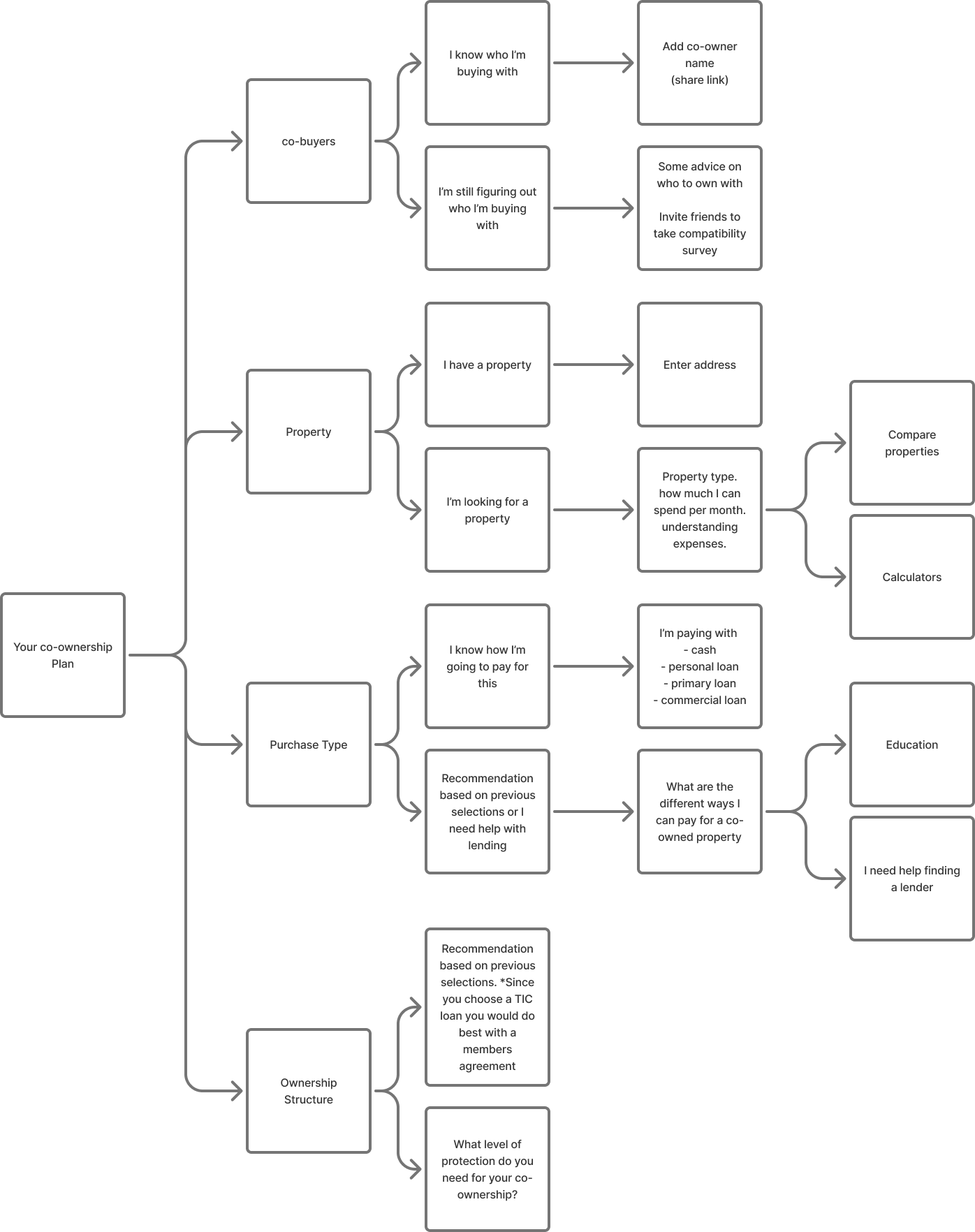
I worked with our founding team to take Joynt from idea to product: research, journey mapping, wireframes, prototypes, visual design, testing, iteration, and eventually front-end and AI-assisted development.
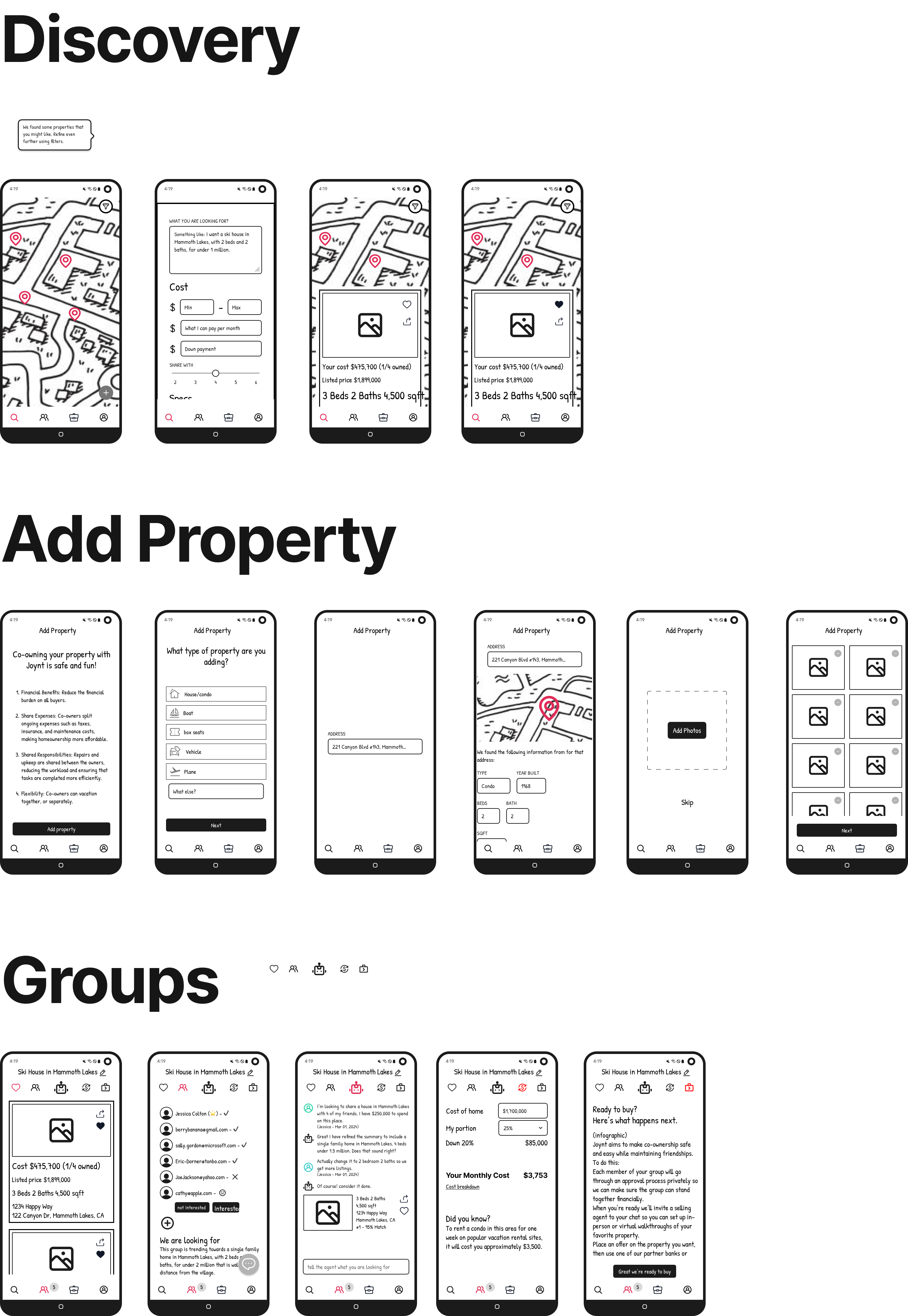
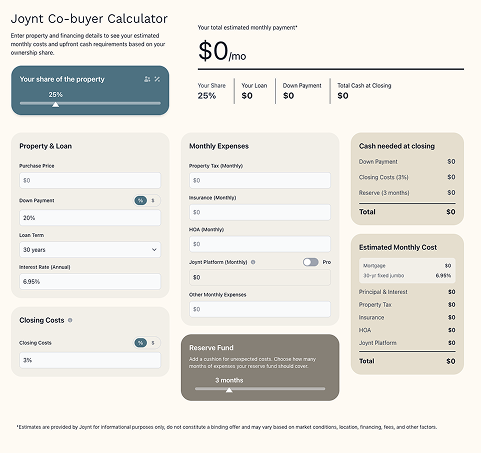
Early on, we experimented with product ideas that could influence product-led conversions. One of our first visions included a real estate search experience where people could browse homes and instantly see what each property might cost if they split it.
Then we learned that the service we planned to use for MLS data was no longer available. Purchasing the data independently was cost prohibitive for us.
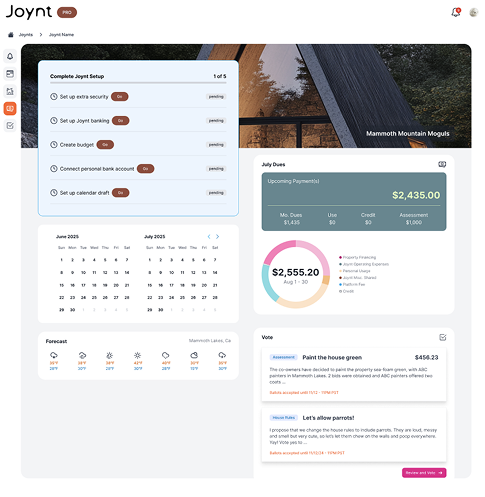
Instead, we ended up doubling down on the problems nobody had solved for co-owning property: affordability, ownership structure, agreements, shared finances, scheduling, decisions, and what happens when an owner wants out.
Reality check #2: The customer
Existing co-owners seemed like an obvious ICP.
Finding them was not.
People don't necessarily call themselves “co-owners,” and “help me manage my co-owned property” isn't exactly a high-volume Google search.
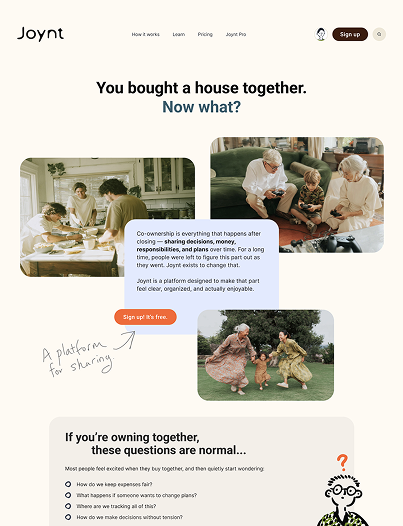
I designed and built the Joynt website and marketing assets in HubSpot, then worked across Google Ads, Meta Ads, SEO, organic social, content, landing pages, email, and nurture campaigns to test how people actually found us and what got their attention.
Our first marketing consultancy was too locked into its niche and caused delays. We changed partners and found a team with serious HubSpot expertise who could build on the systems we already had.
Meanwhile, our experiments exposed something bigger: there was a lot of interest in the affordability crisis especially in younger generations.
That pushed both the marketing and the product upstream, toward people still trying to figure out how they could afford a home in the first place.
It also reinforced something I've run into more than once: the more audiences you're trying to speak to at the same time, the more your message becomes diluted. And it's also a challenge to give campaigns plenty of time to gauge interest.
The work kept crossing boundaries.
Product decisions became marketing questions. Marketing experiments changed the product. Customer conversations changed the messaging. Technical constraints changed the experience.
That's one of the things I loved most about building Joynt.
In a small founding team, there was no room for “that's not my department.” I could move from a product flow to a campaign to a customer problem to code, and have a voice in the decisions connecting all of it.
The boundaries between product, brand, marketing, design, and technology got pretty blurry, and that's great.
Thoughts on this experience.
Don't defend ideas without evidence.
Chase down problems quickly and move on.